Differential temperature effects are silent but powerful forces in long-span bridges. Unlike traffic load, temperature acts every day and affects the entire structure.
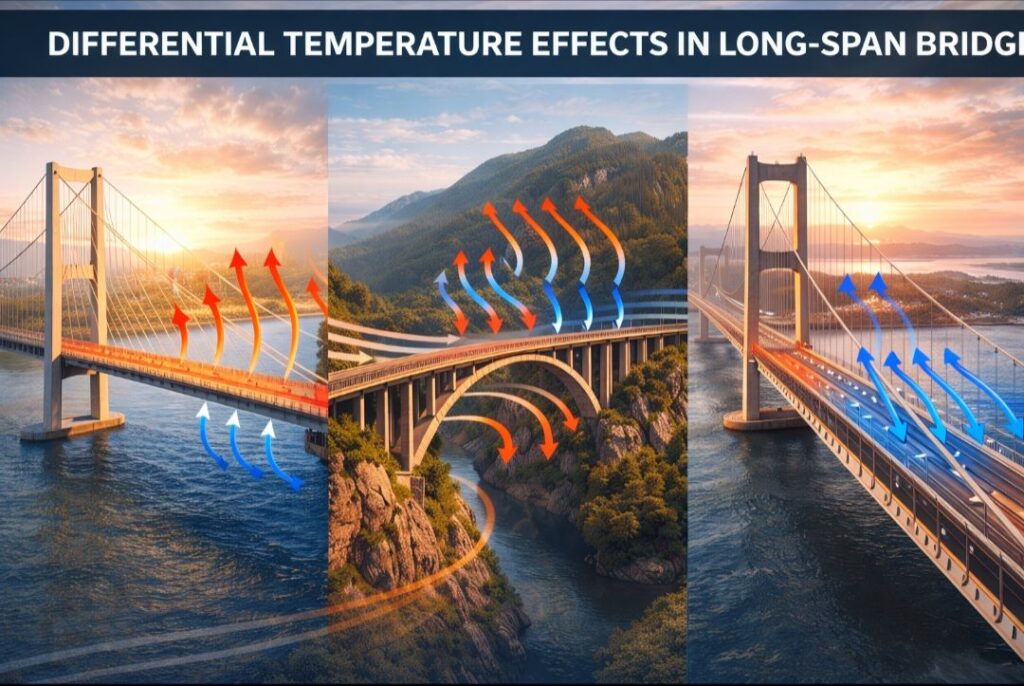
Temperature does not act uniformly on long-span bridges. Different parts of the structure heat and cool at different rates. This uneven temperature distribution creates internal stresses, rotations, and movements that engineers must predict accurately during design. In long spans above 150 m, temperature effects can become as critical as live load.
Concrete decks absorb solar radiation quickly during the day. Steel components respond faster to temperature change than concrete. The top flange of a box girder may become significantly hotter than the bottom flange under direct sunlight. These differences generate bending effects even when no vehicles are present on the bridge.
Ignoring differential temperature effects can lead to cracking, bearing distress, excessive joint movement, cable force variation, and long-term durability problems.
Modern bridge engineering therefore treats temperature gradients as a primary design load case, especially for cable-stayed and suspension bridges.
What Is Differential Temperature?
Uniform temperature change causes expansion or contraction of the entire bridge length. Engineers account for this using expansion joints and bearings. Differential temperature, however, occurs when temperature varies across the depth or width of the section.
For example, on a 300 m cable-stayed bridge, the deck surface exposed to sunlight may reach 55°C, while the underside remains near 30°C. This 25°C gradient across a 3 m deep section produces curvature. The deck bends downward or upward depending on the gradient direction.
The effect is not small. Even a 10°C gradient across a deep box girder can induce measurable deflection and stress redistribution.
Why Long Spans Are More Sensitive
Short bridges below 30 m are stiff relative to their length. Thermal gradients produce limited curvature. Long-span bridges are slender and flexible. Their span-to-depth ratios are high. Small thermal curvature translates into larger vertical displacement at midspan.
Consider a 40 m prestressed concrete beam bridge and a 600 m cable-stayed bridge. The 40 m bridge experiences temperature gradient, but deflection remains minimal due to high stiffness. While the 600 m bridge, however, may experience noticeable deck rotation and cable force variation because:
• The deck is slender
• The span length magnifies curvature
• Stay cables respond to deck movement
• Bearings accommodate large movements
This amplification effect explains why differential temperature is more critical in long-span structures.
Types of Temperature Effects in Bridges
Temperature effects in bridges generally fall into three categories:
- Uniform temperature change
- Vertical temperature gradient
- Transverse temperature gradient
Uniform change affects overall expansion. Vertical gradients cause bending about the horizontal axis.Transverse gradients cause twisting across the deck width.
In wide box girder bridges exceeding 25 m deck width, transverse gradients can induce torsion. One side of the deck exposed to afternoon sun may expand more than the shaded side, creating rotation.
Project Example: 400 m Cable-Stayed Bridge
Imagine a 400 m main span cable-stayed bridge in a tropical region. Afternoon solar radiation heats the deck top significantly. The bottom slab remains cooler.
The deck develops downward curvature due to the hotter top layer expanding more than the bottom layer. This curvature changes the geometry of stay cables. Cable forces adjust to maintain equilibrium.
If not properly analyzed, the designer may underestimate:
• Cable stress variation
• Pylon bending moments
• Bearing reactions
• Expansion joint movement
Repeated daily temperature cycles also introduce fatigue concerns, especially at cable anchorages.
Effect on Different Bridge Types
Beam Bridges
Differential temperature rarely governs design. Crack control reinforcement handles minor stresses. Expansion joints manage uniform movement.
Arch Bridges
Temperature gradients can induce additional thrust in arch ribs. If abutments are stiff, internal force increases. In steel arches, temperature difference between arch rib and deck may create secondary stresses.
During construction, partially completed arches are especially vulnerable because stiffness distribution is incomplete.
Cable-Stayed Bridges
These bridges are highly sensitive to temperature variation. Stay cable forces fluctuate daily. Designers must evaluate serviceability conditions to ensure cable tension remains within allowable limits.
Cable elongation due to heat may reduce tension temporarily. Cooling at night increases tension again. These cyclic variations require fatigue consideration.
Suspension Bridges
Suspension bridges experience significant longitudinal expansion due to their length. Main cables expand noticeably. The deck may move several hundred millimeters between extreme temperature conditions.
Differential gradient also affects stiffening girders. Because suspension bridges are flexible, serviceability limits often govern temperature design.
Structural Analysis Approach
Modern bridge design codes provide temperature gradient models based on climatic region. Engineers apply:
• Uniform temperature load case
• Positive vertical gradient
• Negative vertical gradient
• Transverse gradient
Finite element models simulate these cases.
Critical responses include:
• Bending moment increase
• Cable force redistribution
• Bearing displacement
• Pylon moment
For bridges exceeding 300 m spans, time-dependent temperature monitoring during operation is sometimes implemented to validate design assumptions.
Construction Stage Temperature Risk
Temperature effects during construction can be more severe than in final configuration. For example, a 250 m cantilever segment during balanced construction may experience significant rotation due to afternoon heating.
If segments are cast at high temperature and later cool at night, internal restraint can produce tensile stress and cracking. Construction scheduling must consider temperature timing.
Mitigation Measures
Engineers reduce differential temperature impact by:
Optimizing deck thickness
Using light-colored surfacing to reduce heat absorption
Designing flexible bearings
Providing adequate expansion joint capacity
Detailing reinforcement for crack control
Monitoring cable forces in cable-supported bridges
In long-span steel bridges, orthotropic decks are carefully designed to limit distortion due to thermal gradients.
Numerical Illustration
Assume a concrete deck depth of 3 m. A vertical temperature gradient of 15°C exists between top and bottom. The curvature induced can be estimated using basic thermal strain relationships.
Thermal strain equals coefficient of expansion multiplied by temperature change.
For concrete, α ≈ 10 × 10⁻⁶ /°C.
Strain difference = 10 × 10⁻⁶ × 15 = 150 × 10⁻⁶.
Over a 3 m depth, curvature produces measurable bending. Across a 500 m span, small curvature generates noticeable deflection.
This simplified example shows why gradient effects cannot be ignored in long spans.
Long-Term Durability Considerations
Repeated daily thermal cycles produce micro-cracking. Over years, this may:
Increase permeability
Accelerate reinforcement corrosion
Reduce stiffness
Affect cable anchorage zones
Bridges in desert or tropical climates face larger temperature ranges than temperate regions. Climatic data must guide design.A
Also See: Wind Effects on Long Span Bridges
Conclusion
Differential temperature effects are silent but powerful forces in long-span bridges. Unlike traffic load, temperature acts every day and affects the entire structure. As span increases beyond 150 m, gradient effects become increasingly significant. Cable-stayed and suspension bridges are particularly sensitive due to flexibility and cable interaction.
Modern bridge engineering treats temperature gradients as a fundamental load case. Accurate modeling, proper detailing, and careful construction planning ensure that daily thermal cycles do not compromise structural safety or durability.
Sources & Citations
- AASHTO (2020). AASHTO LRFD Bridge Design Specifications, 9th Edition. American Association of State Highway and Transportation Officials, Washington, D.C.
- EN 1991-1-5 (2003). Eurocode 1: Actions on Structures – Part 1-5: Thermal Actions. European Committee for Standardization (CEN), Brussels.
- Gimsing, N. J., & Georgakis, C. T. (2012). Cable Supported Bridges: Concept and Design, 3rd Edition. John Wiley & Sons.
Chen, W. F., & Duan, L. (2014). Bridge Engineering Handbook, 2nd Edition. CRC Press. - Hambly, E. C. (1991). Bridge Deck Behaviour, 2nd Edition. E & FN Spon.
