This article examines construction tolerances from a structural perspective, not as workmanship trivia but as parameters that can materially alter structural behaviour.
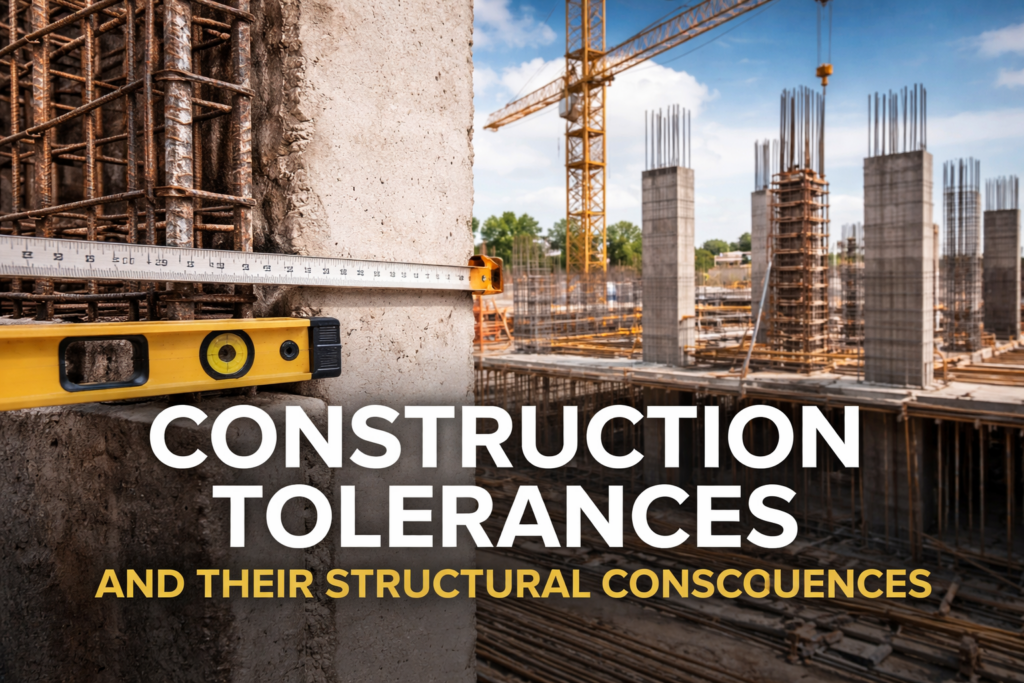
Structural design is built on assumptions. Dimensions are assumed exact, members are assumed aligned, loads are assumed to act where intended, and connections are assumed to behave as detailed.
Construction, however, operates in the real world. Concrete does not pour itself perfectly into formwork, steel does not always sit exactly where it was drawn, and trades rarely execute work with mathematical precision. The gap between what is assumed in design and what is delivered on site is governed by construction tolerances. These tolerances are not peripheral issues; they directly influence structural performance.
Despite their importance, construction tolerances are frequently treated as secondary considerations. Many engineers implicitly assume that small deviations will “average out” or be absorbed by safety factors. This assumption is dangerous.
Tolerances affect load paths, eccentricities, member slenderness, stiffness distribution, and even failure modes. In many real-world failures, calculations were correct, materials met specification, yet the structure underperformed because tolerances were ignored or misunderstood.
This article examines construction tolerances from a structural perspective, not as workmanship trivia but as parameters that can materially alter structural behaviour. It explains where tolerances originate, how they interact with analysis assumptions, and why engineers must actively consider them rather than relying on vague notions of conservatism.
What Construction Tolerances
Actually Represent
Construction tolerances define the acceptable limits of deviation from specified dimensions, positions, and alignments during construction. They recognise that perfect execution is impossible and that a controlled range of error is inevitable. These limits may relate to verticality of columns, plan position of foundations, thickness of slabs, cover to reinforcement, or alignment of steel members.
From a structural standpoint, tolerances are not merely quality control thresholds.
They are geometric variations that influence how forces are introduced and resisted. A column that is 20 mm out of plumb does not simply “look untidy”; it introduces unintended bending moments. A footing cast 50 mm off its intended position alters eccentricity and soil pressure distribution. A beam with reduced effective depth due to cover deviations loses moment capacity.
Design calculations typically assume nominal geometry. The moment a structure deviates from that geometry, the internal force distribution changes. Whether this change is negligible or critical depends on how sensitive the structure is to geometric imperfections. Slender elements, indeterminate frames, and stability-governed systems are particularly vulnerable.
Tolerances Versus Design Assumptions
Most structural analyses assume idealised geometry. Columns are vertical, beams are straight, nodes are perfectly connected, and supports are exactly where intended. These assumptions are necessary to make the problem solvable, but they are abstractions, not reality. Construction tolerances are the bridge between abstraction and execution.
Problems arise when engineers treat tolerances as someone else’s problem, usually the contractor’s. In truth, tolerances must be anticipated at the design stage. If a structure is highly sensitive to small deviations, then either tighter tolerances must be specified and enforced, or the design must be made more robust to accommodate likely deviations.
For example, a slender reinforced concrete column designed close to its axial capacity may perform adequately only if perfectly vertical. Introduce a small lateral deviation within permitted tolerances, and second-order effects can dominate. The structure has not changed, but the assumptions underpinning the design have.
This is why codes implicitly and explicitly account for imperfections. They acknowledge that tolerances exist and that structural behaviour must be assessed with them in mind. Ignoring this relationship is not conservative; it is
negligent.
Verticality and Alignment of Columns
Column verticality is one of the most critical tolerance-related issues in buildings. Even small deviations introduce eccentric axial loads, resulting in additional bending moments. In stocky columns, this may be absorbed without noticeable consequence. In slender columns, especially in multi-storey frames, the effects can be severe.
A column that is out of plumb by only a few millimetres per storey accumulates lateral displacement over height. This displacement produces additional moments that were not part of the original design. In braced frames, this may increase axial forces in braces. In moment-resisting frames, it can alter stiffness distribution and attract higher moments to certain members.
Crucially, these effects do not announce themselves dramatically. There is often no visible cracking or distress initially. Instead, the structure quietly operates closer to its limits, with reduced reserve capacity. Engineers who dismiss column tolerances as cosmetic misunderstand their structural significance.
Foundation Position and Level Tolerances
Foundation tolerances are another underestimated source of structural consequence. A footing cast off-centre introduces eccentricity into column loads. This changes soil pressure distribution, potentially exceeding allowable bearing pressures on one side while underutilising capacity on the other.
Differential foundation levels can also induce unintended moments and secondary stresses. When a column base is higher or lower than assumed, load transfer paths change. In rigid frames, this can introduce compatibility stresses that were never analysed. In precast systems, misalignment at foundations often propagates through the entire superstructure.
Foundation tolerances are especially critical in structures governed by uplift, overturning, or sliding. Small geometric deviations can significantly affect stabilising and destabilising moments. Designing such systems without explicitly considering tolerance-induced eccentricities is a common but serious oversight.
Reinforcement Placement and Cover Deviations
Reinforcement tolerances are often discussed in terms of durability, but their structural implications are just as important. Reduced effective depth due to excessive cover directly lowers flexural capacity. Conversely, insufficient cover may increase capacity marginally but compromises durability and fire resistance.
Congested reinforcement, often the result of overdesign, makes correct placement difficult. Bars end up displaced, bent, or layered incorrectly. The designer may have specified adequate reinforcement, but the as-built arrangement behaves differently. Shear links not positioned correctly reduce shear capacity. Laps placed in high-stress zones weaken the member.
These are not workmanship excuses; they are predictable outcomes of designs that ignore constructability and tolerance realities. A design that cannot be built accurately within reasonable tolerances is a flawed design.
Steel Structures and Accumulated Tolerances
In steel structures, tolerances accumulate rapidly. Fabrication tolerances, erection tolerances, and connection tolerances compound across multiple members. A small deviation at each level can result in significant misalignment over height or span.
Misaligned steel members introduce unintended stresses at connections. Bolts experience prying forces, welds see secondary stresses, and bearings do not distribute load evenly. In statically determinate structures, this may be manageable. In indeterminate frames, it can lead to stress redistribution far from what was assumed in design.
The idea that steel structures are “forgiving” is misleading. They are precise systems that rely on controlled geometry. When tolerances are exceeded or poorly managed, the structure responds, often in ways that analysis did not anticipate.
Codes, Imperfections, and Engineering Responsibility
Design codes recognise the existence of imperfections. They incorporate them through imperfection factors, notional loads, and minimum eccentricities. These provisions are not optional extras; they are fundamental acknowledgements of construction reality.
However, codes cannot account for every site-specific deviation. The engineer’s responsibility is to understand where tolerances matter most and to design accordingly. This may involve specifying tighter tolerances, detailing to accommodate movement, or increasing robustness in critical elements.
Importantly, this does not mean indiscriminate overdesign. It means intelligent design. A structure that performs safely despite expected tolerances is well designed. A structure that relies on perfect execution is not.
Why Tolerances Are Often Ignored
The uncomfortable truth is that tolerances are often ignored because their consequences are subtle. They rarely cause immediate collapse. Instead, they erode margins quietly. They reduce redundancy. They make structures less forgiving under abnormal loads or future modifications.
There is also a contractual dimension. Tolerances sit at the intersection of design and construction responsibility. When things go wrong, parties argue about whose fault the deviation was. This ambiguity encourages designers to avoid engaging with tolerances altogether.
But history shows that many disputes and failures hinge on these very issues. Structures do not fail because of one dramatic mistake, but because many small deviations combine in ways no one anticipated.
Conclusion
Construction tolerances are not secondary details to be left to site engineers and contractors. They are structural parameters that influence load paths, stresses, and failure modes. Ignoring them does not make a design conservative; it makes it fragile.
Good structural engineering acknowledges reality. It accepts that construction is imperfect and designs accordingly. This requires judgment, experience, and a willingness to engage with uncomfortable details. Structures that perform well are not those that assume perfection, but those that remain safe despite imperfection.
