This article presents a detailed treatment of wind load application on guyed towers using the Eurocode framework. It addresses wind action modelling, load distribution, global analysis, and member design.
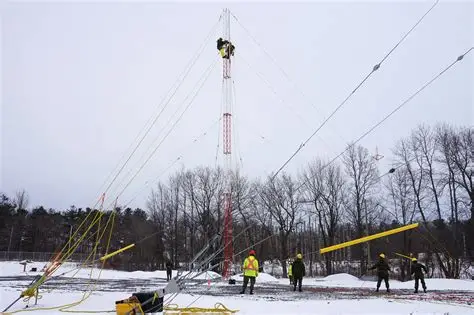
Guyed towers remain one of the most efficient structural systems for supporting antennas, transmission equipment, and lightweight vertical installations. Engineers favour them because they achieve significant heights using minimal steel weight, relying on guy cables to provide lateral stability. This efficiency, however, introduces complexity. The structure behaves as a highly flexible system whose response is dominated by wind action rather than gravity loading. Hence, wind governs both global behaviour and local member design.
Unlike self-supporting towers, guyed towers interact continuously with the surrounding air flow. Wind induces drag forces on the mast, on the guys, and on the attached appurtenances. These forces redistribute through the guy system and into the foundations in a highly non-linear manner. Small changes in wind pressure, terrain category, or guy pretension can significantly alter internal forces. A rigorous and transparent wind load application procedure is therefore essential.
This article presents a detailed treatment of wind load application on guyed towers using the Eurocode framework. It addresses wind action modelling, load distribution, global analysis, and member design. A worked example is included to demonstrate practical application and to remove ambiguity often seen in tower design submissions.
Governing Standards and Design Framework
The design of guyed towers subjected to wind action relies on a coordinated application of several European standards. EN 1991-1-4 defines the wind actions, while EN 1993-3-1 governs the structural resistance and verification of towers and masts. EN 1993-1-1 provides the design rules for steel members, and EN 1993-1-11 covers tension components, including guy cables.
Ultimate and serviceability verification follows the limit state philosophy. Designers must satisfy Ultimate Limit States (ULS) for strength and stability and Serviceability Limit States (SLS) for deflection, rotation, and vibration control. Wind action typically governs both limit states for guyed towers due to their slenderness and low inherent damping.
The selected National Annex specifies the partial safety factors for wind actions and material strengths. This reliability format explicitly accounts for uncertainties in wind climate, structural modelling, and construction tolerances through these factors. Additional conservatism beyond this framework requires explicit justification.
Structural Behaviour of Guyed Towers Under Wind
Guyed towers behave as tension-stabilised systems. The mast resists axial compression and bending, while the guy cables provide lateral restraint through tensile action. Wind induces transverse loading on the mast and the guys, causing mast bending, guy force redistribution, and foundation reactions.
The structure exhibits geometric nonlinearity. Increased wind load increases mast deflection, which alters guy angles and tension forces. This second-order behaviour must be captured either through nonlinear analysis or conservative equivalent linear methods. Ignoring this interaction leads to unconservative force estimation, particularly in the windward and leeward guys.
Dynamic effects may also arise. Tall, slender towers are susceptible to vortex shedding and galloping. While this article focuses on static wind loading, designers must verify whether dynamic response requires further assessment using EN 1991-1-4 Annex E.
Determination of Wind Action
Basic Wind Velocity
The basic wind velocity is defined as:
v_b = c_{dir} \cdot c_{season} \cdot v_{b,0}
where ( v_{b,0} ) is the fundamental basic wind velocity obtained from the National Annex. Also, directional and seasonal factors usually equal unity unless justified otherwise.
Mean Wind Velocity
The mean wind velocity at height ( z ) is given by:
v_b = c_{dir} \cdot c_{season} \cdot v_{b,0}
The roughness factor ( c_r(z) ) depends on terrain category and height. Guyed towers often extend through multiple terrain influence zones, requiring careful evaluation of wind speed variation along the mast.
Peak Velocity Pressure
The peak velocity pressure is calculated as:
q_p(z) = \left[ 1 + 7 I_v(z) \right] \cdot \frac{1}{2} \rho v_m^2(z)
where ( I_v(z) ) is the turbulence intensity and ( \rho ) is air density, typically taken as 1.25 kg/m³.
This pressure forms the basis for all wind force calculations.
Wind Forces on the Mast
The wind force per unit height on the mast is determined using:
F_w(z) = q_p(z) \cdot c_f \cdot A_{ref}
The force coefficient ( c_f ) depends on mast shape. Lattice masts use solidity-based coefficients, while tubular masts use diameter-based values. Reference area ( A_{ref} ) corresponds to the projected area normal to the wind direction.
Designers must divide the mast into height segments and apply varying wind pressures accordingly. Applying a uniform pressure over the entire height is generally unconservative for tall towers.
Wind Forces on Guy Cables
Guy cables experience wind drag along their exposed length. The wind force per unit length is expressed as:
f_{wg} = q_p(z) \cdot c_{fg} \cdot d_g
where ( c_{fg} ) is the drag coefficient for circular cables and ( d_g ) is the cable diameter.
These forces act normal to the cable axis and introduce additional tension. Windward guys typically experience increased tension, while leeward guys may experience tension reduction, sometimes approaching slack conditions. Designers must check both extremes.
Load Combinations for Wind
For Ultimate Limit State verification, the governing combination typically takes the form:
\gamma_G G_k + \gamma_Q Q_k + \gamma_W W_k
Wind often acts as the leading variable action. The partial factor ( \gamma_W ) is taken from the National Annex, commonly 1.5. Companion variable actions are reduced using combination factors ( \psi_0 ).
Serviceability combinations usually apply wind with a factor of 1.0 to assess deflections and rotations.
Global Structural Analysis
The analysis requires a three-dimensional model. Beam elements represent the mast, while tension-only cable elements with initial pretension represent the guy systems. The foundations are modelled as pinned or elastic supports, depending on the available geotechnical data.
Analysis Model
Pretension values significantly influence results. Designers must apply pretension consistent with construction specifications and verify sensitivity to reasonable variation.
Second-Order Effects
Second-order effects arise due to large displacements and cable force redistribution. Eurocode requires consideration of these effects where they significantly influence internal forces. For guyed towers, they almost always do.
Nonlinear geometric analysis provides the most reliable results. If linear analysis is used, designers must apply amplification factors justified by structural behaviour.
Member Design of the Mast
Mast members typically resist combined axial compression and bending. Verification follows:
\frac{N_{Ed}}{N_{b,Rd}} + \frac{M_{Ed}}{M_{b,Rd}} \leq 1.0
Buckling resistance depends on effective length, which is influenced by guy spacing and stiffness. Designers must justify assumed effective lengths rather than adopting arbitrary conservative values.
Local buckling checks are required for tubular sections, particularly under high compressive stress ranges caused by wind reversal.
Design of Guy Cables
Guy cables are designed as tension members according to EN 1993-1-11. The design resistance is:
N_{Rd} = \frac{A \cdot f_{yk}}{\gamma_M}
Design tension must consider initial pretension, wind-induced increment, and temperature effects. Fatigue assessment may be required for sites exposed to frequent wind cycling.
Connections at anchors and mast attachments often govern design. These must be checked for combined axial force and bending effects induced by cable inclination.
Foundations and Anchor Design
Wind loads transfer through the guy system into anchor foundations. Designers must verify uplift, sliding, and bearing resistance. Load combinations must include maximum and minimum guy forces to capture critical uplift scenarios.
Anchor failure represents a disproportionate collapse risk. Robustness considerations therefore require conservative detailing, even when analytical forces appear modest.
Worked Example
Consider a 60 m high guyed mast with three levels of guys at 20 m, 40 m, and 60 m. The mast is tubular with an outer diameter of 400 mm. The site terrain corresponds to Category II. Basic wind velocity is 26 m/s.
Wind Pressure
At 60 m height:
v_m(60) = c_r(60) \cdot v_b
v_m(60) = 1.35 \cdot 26 = 35.1 \ \text{m/s}
q_p(60) = \left[ 1 + 7(0.15) \right] \cdot \frac{1}{2} \cdot 1.25 \cdot 35.1^2 = 1580N/m^2
Mast Wind Force
F_w = q_p \cdot c_f \cdot d
F_w = 1580 \cdot 1.2 \cdot 0.4 =758.4N/m
This force is applied incrementally along the mast height.
Guy Tension Increase
Assuming a cable diameter of 20 mm:
f_{wg} = 1580 \cdot 1.0 \cdot 0.02 = 31.6N/m
Integrated over cable length, this produces a significant tension increment that must be combined with pretension for design.
Serviceability Checks
Deflection limits are governed by antenna performance requirements. Excessive mast top displacement can impair signal alignment. Designers must verify top displacement and rotation under characteristic wind loading.
Conclusion
Wind action governs the design of guyed towers in almost all practical situations. Proper application requires more than applying a single pressure value and hoping for the best. It demands segmented loading, nonlinear analysis, realistic pretension modelling, and disciplined member verification.
Also See: Structural Design of Guyed Towers to Eurocode
Sources & Citations
- European Committee for Standardization (CEN)
EN 1991-1-4: Eurocode 1 – Actions on structures – Part 1-4: General actions – Wind actions.
Brussels: CEN. - European Committee for Standardization (CEN)
EN 1993-3-1: Eurocode 3 – Design of steel structures – Part 3-1: Towers, masts and chimneys.
Brussels: CEN. - European Committee for Standardization (CEN)
EN 1993-1-11: Eurocode 3 – Design of steel structures – Part 1-11: Design of structures with tension components.
Brussels: CEN. - Institution of Structural Engineers (IStructE)
Manual for the Design of Guyed Masts.
London: IStructE. - CIRIA
Guide to the Design of Anchors and Anchor Foundations for Towers and Masts.
London: Construction Industry Research and Information Association.
